what happened to glucose during diffusion and osmosis lab
AUSTRALIAN CURRICULUM ALIGNMENT:
- Movement of materials beyond membranes occurs via diffusion, osmosis, agile transport and/or endocytosis
Background:
The cell membrane maintains the jail cell a separate entity; information technology holds the cell contents within, and acts every bit a barrier to the external environment. Information technology is selectively permeable and has various mechanisms to allow for the commutation of gases and nutrients. These mechanisms allow for the intake of annihilation that is required and allows for the expulsion of waste product and toxins. This membrane does not resemble a sheet or bag; rather, it is many molecules of Phospholipid Bilayers held together by the combined forces of attraction and repulsion. They are comprised of a Phosphate head; which is hydrophilic (h2o-loving), and a Lipid (fat acid) tail which is hydrophobic (repelled by water). Every bit the internal and external environments of a cell are aqueous, these molecules conform themselves into two layers; 1 with the Phosphate heads oriented out into the external fluid, and the other with the heads oriented inwards into the internal fluid (the Cytoplasm). The Lipid tails are between the 2 layers of Phosphate heads; thereby, protected from the water, and the force of this attraction/repulsion mechanism keeps the molecules together every bit though the membrane were a single entity.
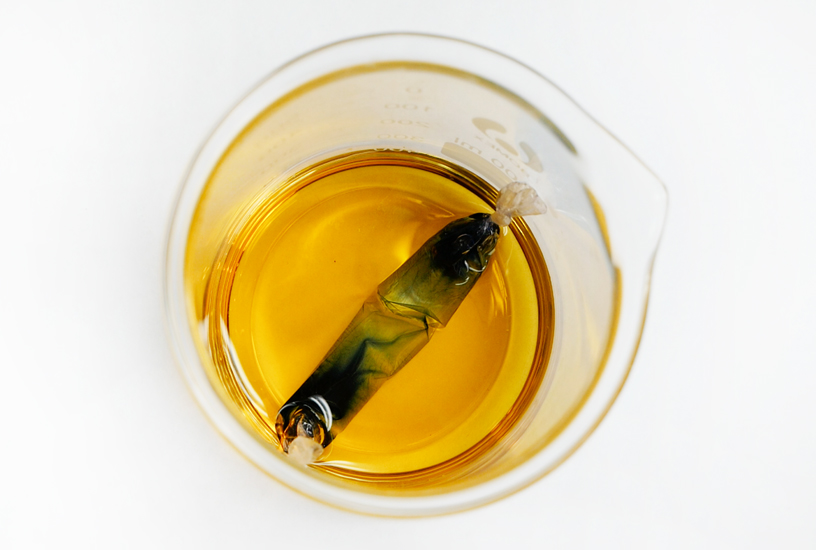
In this practical, dialysis tubing is used as a surrogate cell membrane for a visual demonstration of osmosis and diffusion. A solution containing large molecules (Starch) and minor molecules (Glucose) is placed within the tubing; which is and so placed in a solution containing iodine. Students are able to observe every bit the solution inside the tubing turns night blue, while the surrounding solution it is submerged in does not. From this, students tin employ their prior noesis of the Starch-Iodine complex to surmise that Iodine is able to laissez passer through the membrane while starch is not. The Glucose-testing strips bespeak that glucose has been able to pass out of the tubing and into the external fluid. Thus proving the tubing allows motion in both directions.
This inexpensive and simple experiment provides students with a clear visual result that finer demonstrates how the size of a molecule can impact its ability to be transported into or out of a jail cell. It besides illustrates the mechanics of improvidence and osmosis past which a prison cell will attempt to create homeostasis, or equilibrium between its inner and outer environments.
PREPARATION - BY LAB TECHNICIAN
- Cut the dialysis tubing into 15cm lengths and soak for 15 minutes in a chalice filled with room temperature distilled water. Prepare one length of tubing per educatee or group. All the same, it is all-time to set actress strips for students, as some strips may tear or leak through handling.
- To create the Starch solution, dissolve 2g of Starch in 100mL of boiling hot water (ii% solution) on a hot plate until the Starch powder has been fully dissolved. Stir as required.
- To create the Glucose solution, dissolve 30g of Glucose in 100mL water (30% solution) and go on stirring until the glucose has been fully dissolved.
- Combine the Starch and Glucose solutions in a single beaker. Use a stirring rod to mix well.
METHOD - STUDENT Activeness
Glucose/ Starch Solution
- Mensurate 5-10 mL of the Glucose/Starch mixture in a minor beaker or test tube.
- To determine the initial glucose concentration inside the Starch/ Glucose solution, y'all volition first need to dilute a sample of the mixture in h2o. To do this, collect 1mL of your mixture using a transfer pipette and add to a test tube filled with 9mL of h2o. Mix using a clean stirring rod.
- Measure out the diluted Starch/Glucose by placing a Glucose-testing strip in the solution, immediately removing information technology and waiting 60 seconds to observe whatsoever colour change. Using the color guide on the testing strip container, determine the approximate Glucose levels, and record the results.
Iodine Solution
- Fill a big beaker with 100mL h2o, and add 1mL of Iodine/KI solution. The solution should appear a yellowish color.
- Measure the Glucose levels of the Iodine solution with some other strip; following the aforementioned procedure as before. Ensure yous record the results.
Preparing the "cell" tubing
- Recollect your soaked piece of dialysis tubing and tie a knot in ane end every bit though you are tying a balloon.
- Using a transfer pipette, one-half-make full the tubing with your undiluted Starch/Glucose solution and tie the other end to create a "cell".
- Submerge the "prison cell" tubing into the Iodine solution.
Observing changes in the "prison cell"
- After 15 minutes, detect whatever color changes in the tubing and in the beaker solution.
- Measure out the Glucose levels in the Iodine solution.
- Advisedly open the tubing and pour the contents into a clean beaker.
- To dilute the tubing contents for Glucose testing, collect 1mL of the contents using a pipette and eolith into a test tube filled with 9mL of water.
- Measure out the Glucose levels in the diluted contents using a Glucose testing strip following the same procedure equally before.
- Tape the results of the Glucose testing.
- Compare the changes in Glucose levels before and after the 15 minute interval.
OBSERVATION AND RESULTS
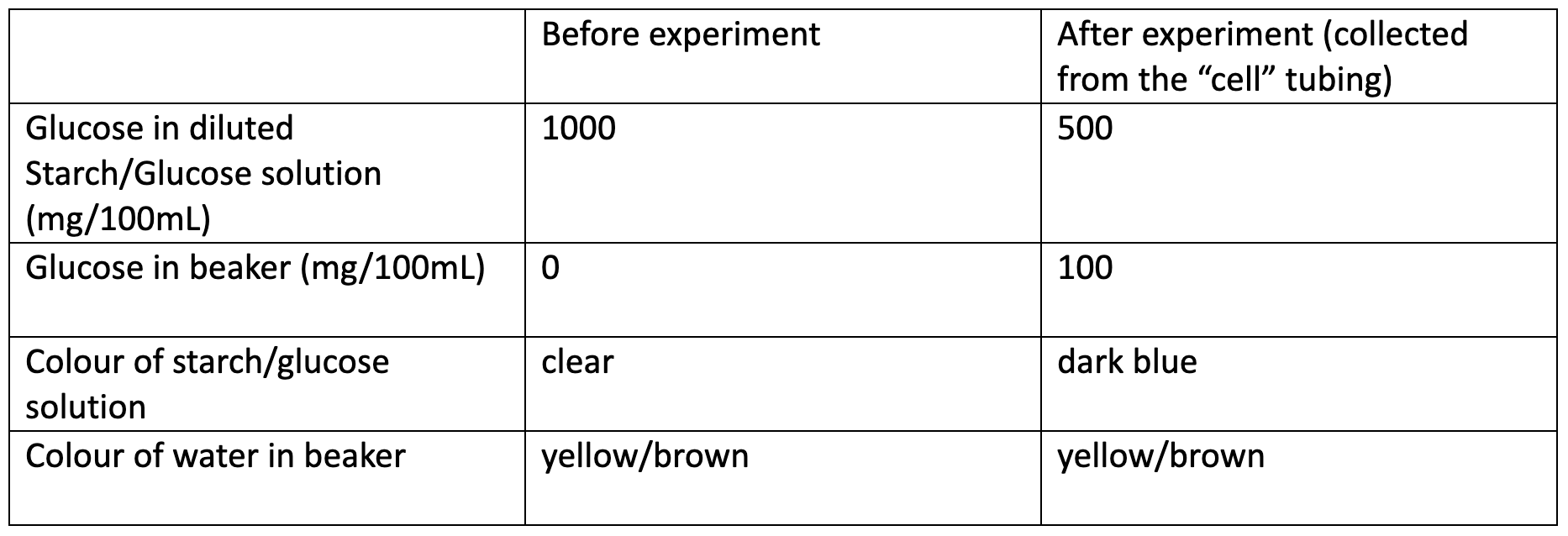
After 15 minutes, the solution inside the tubing should begin to turn blue while the surrounding liquid remains yellowish/brown. Starch molecules are too large to pass through the membrane; nevertheless, the Iodine molecules are pocket-sized plenty. This results in a Starch-Iodine complex that is confined to where the Starch is trapped - ie, within the "cell". Conversely, the Glucose molecules are free to pass through the membrane, and thus will begin to diffuse out in an attempt to equilibrate the Glucose concentration of the two solutions. Beneath is an instance of possible results for the experiment.
INVESTIGATION
- Provide students with the data that you prepared a 100mL solution of ii% starch and a 100mL solution of 30% Glucose. Based on this information, inquire your students to summate the concentration of each in the combined solution. Students should empathize that double the volume without actress solute means half the concentration, so what was 2g of Starch in 100mL (2%) is now 2g of Starch in 200mL (1%); and what was 30g of Glucose in 100mL (30%) is now 30g of Starch in 200mL (15%).
- Ask students to identify what occurred the Starch, based on the fact that the blue color is found inside the cell but non outside of it, students should exist able to place that the Starch has not been able to pass through the tubing, while the Iodine has. Students should understand that the Starch-Iodine complex has therefore been confined to the area where both Starch and Iodine are found, that is, the within of the cell.
- Ask students to describe what is suggested by the Glucose results. The appearance of Glucose into the previously Glucose-free solution in the chalice should inform students that Glucose has been able to pass through the membrane.
- To provide students with a deeper understanding surrounding the molecular size of Glucose and Iodine, you may provide students with the information that our dialysis tubing typically allows passage to molecules of upwardly to 12,000 to xiv,000 daltons (thou/mol). This should provide some guidance of the sizes that Starch molecules can reach. Remind students, however, that the shape of a molecule may bear on the passage equally a large linear molecule may be able to laissez passer through more easily than a smaller just globular molecule.
TEACHER NOTES
The concentration of Glucose in this practical is quite high to enable shorter waiting times for students. This allows them to more readily measure the glucose which has diffused out of the "cell" using their exam strips. Notwithstanding, this also ways that the initial concentration is as well high to show that the concentration inside the cell has decreased in line with the increment outside the cell. To manage this, students are asked to take a sample of the original combined Glucose/ Starch solution prior to beingness placed in the "cell" and also a sample of the now-blue solution inside the "jail cell" at the cease of the prac. Both solutions are diluted past a gene of x to bring the Glucose concentration into the range of the Uriscan strips.
EXTENSION EXERCISE
To observe the process of cell diffusion and osmosis over an extended menses of fourth dimension, make an extra "cell" and keep it in solution until the next class. Past the get-go of next grade, the Glucose within and outside the cell should have somewhat equalised. This could be conducted as a class demonstration, or each educatee may make an extra cell. Once more, dilute both solutions by a gene of ten prior to measuring.
TEACHER TIPS:
-
Prepare extra dialysis strips for students, as some strips may tear or leak through handling as students attempt to necktie them.
 Time Requirements
- 45 mins
 Material List
-
Dialysis tubing
- Starch
- Iodine/KI solution
- Glucose
- Glucose-testing strips
- Exam tubes
- Examination tube rack
- Beakers 500mL
- Beakers 100mL
- Transfer pipettes
- Water
- Stirring rod
 Safety Requirements
- Wear advisable personal protective equipment (PPE); particularly gloves and a lab coat as Iodine will stain clothing and skin on contact.
- Do caution when handling the chemicals used in this prac.
- Avoid any direct contact with the solution and wash hands thoroughly.
 Helpful Links
Source: https://www.southernbiological.com/osmosis-and-diffusion/
0 Response to "what happened to glucose during diffusion and osmosis lab"
Post a Comment